
Cold Energy Storage Technology Comparison

This study contrasts Chilled Water and Solid Ice Storage with EnergiVault, a hybrid solution securing the benefits of both systems whilst eliminating their performance limitations.


Cooling Flexibility
EnergiVault versus competing storage options

Feature
EnergiVault
Traditional Ice Tanks
Ice Bricks
Energy density
High (slurry PCM)
Low
Medium
Response speed
Instant
Slow
Moderate
Footprint
Compact / modular
Large tanks
Modular
Degradation
None
None
None
Controls
Advanced optimisation-ready
Basic
Limited
Use cases
Peak shaving, backup, optimisation
Load shifting
Load shifting
Ice

Solid Ice Storage

- Poor discharge capacity

- Low energy flexibility

- Poor responsiveness to sudden cooling demand

- Inefficient charging

Water

Chilled Water Storage

- Poor temperature control

- Low energy density

- > 8x volume and higher footprint

Battery OHX

Electrical Energy Storage

- High capital cost

- Limited lifecycles

- Degradation over time

- Low real turnaround efficiency

- High-capacity connection

- Storage without connected generation (Fault - Level) contribution; can add more generation instead

Logo

EnergiVault® Thermal Battery

- Easy Integration with renewables to reduce energy and Co2

- High peak cooling versus input power

- Ultrafast response to cooling demand

- No lifetime degradation

- >20- year lifetime

- Highly scalable

- Low footprint
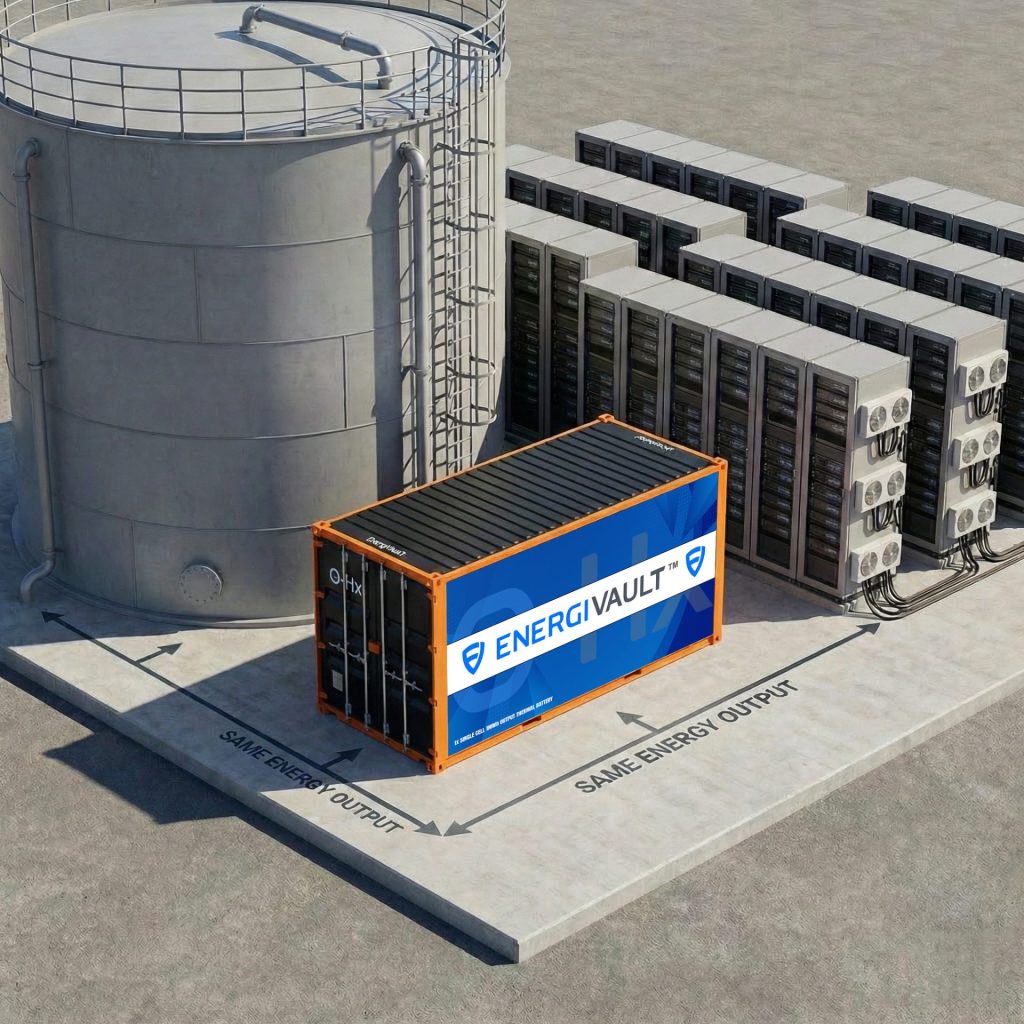
Chilled water systems require 8x the volume of an equivalent Energivault system

Facilities managers and HVAC engineers are constantly searching for ways of reducing energy costs and carbon emissions through load shifting, load levelling and integration with on-site renewables.

A commonly used solution is chilled water storage, less common is solid ice storage.

Both these “cool storage” approaches can provide energy cost savings, reduce peak time non commodity costs such as transmission and distribution charges, provide peak cooling capacity and optimise on-site renewable generation, all in addition to back-up cooling for added resilience.

Traditional chilled water buffer tanks have been the industry standard for decades, but the physical and financial costs are becoming increasingly difficult to justify. A typical 220,000-litre insulated tank requires massive civil engineering works, including deep concrete foundations and extensive site preparation that can dominate valuable space. Beyond the construction disruption, these systems often come with high thermal losses and significant hidden fluid costs.


When attached directly to water chiller systems, these tanks require a mixture of water, 30% propylene glycol, and various chemical additives to prevent corrosion and bacterial growth. At current bulk prices, the glycol and chemicals for a single large tank can exceed £100,000. This is a substantial capital outlay that EnergiVault eliminates entirely. It simplifies the system design by removing the need for complex fluid management and expensive long-term chemical maintenance.

The EnergiVault thermal battery provides a far more efficient alternative by dramatically shrinking the physical footprint. It reduces the area required for a standard 220,000-litre tank down to a compact 6m x 2.2m space. While earlier phase change material technologies suffered from slow discharge rates, EnergiVault delivers an immediate response with peak discharge rates up to 1MW per battery cell. This allows it to match or exceed the performance of traditional buffer tanks in a fraction of the space.

For facility managers and specifiers, this represents a significant shift in cooling strategy. The installed cost is typically 40% lower than equivalent chilled water storage, and because the system is a removable, relocatable asset rather than a fixed concrete monument, it avoids the headaches of planning permissions and major civil works. It arrives complete with integrated charging and seamless BMS integration, offering a modular and sustainable solution that remains fully compatible with pressurised systems.

EnergiVault
Why EnergiVault isn’t conventional CTES

Most cold-thermal energy storage systems are designed to discharge slowly over hours.
That works for energy shifting but not for real-world cooling peaks.
EnergiVault® is engineered for fast, high-power cooling delivery.
 
Conventional CTES
EnergiVault®
Slow, low-power discharge
Rapid, high-power cooling on demand
Best for long-duration load shifting
Built for peak shaving & fast response
Limited role in resilience
Supports N+1 and short-duration backup cooling
Often oversized to meet peaks
Reduces chiller and electrical oversizing
Passive storage
Active, controllable cooling asset
The Result:
Lower peak demand, smaller plant, improved efficiency and cooling that responds when it actually matters.

Not just storage. Performance cooling.

“Designed for power-dense cooling, not slow thermal discharge.”