Cannes Success: Redefining Thermal Storage for the AI Era
A week in Cannes discussing digital infrastructure, energy, cooling, and AI made one major theme impossible to ignore. Specifically, AI is not just a compute challenge. Consequently, it has become a serious power and thermal resilience challenge.
Therefore, the next generation of data centres faces entirely new limits. Chips, land, or fibre are no longer the main bottlenecks. Instead, grid capacity, peak cooling demand, and rapid thermal load changes from high-density AI workloads will limit growth in many markets.
Shifting the Focus to Capacity
As a result, operators are now completely rethinking thermal storage. It is no longer simply an energy-efficiency measure or a way to shift cooling tariffs. Furthermore, it has become a critical capacity tool.
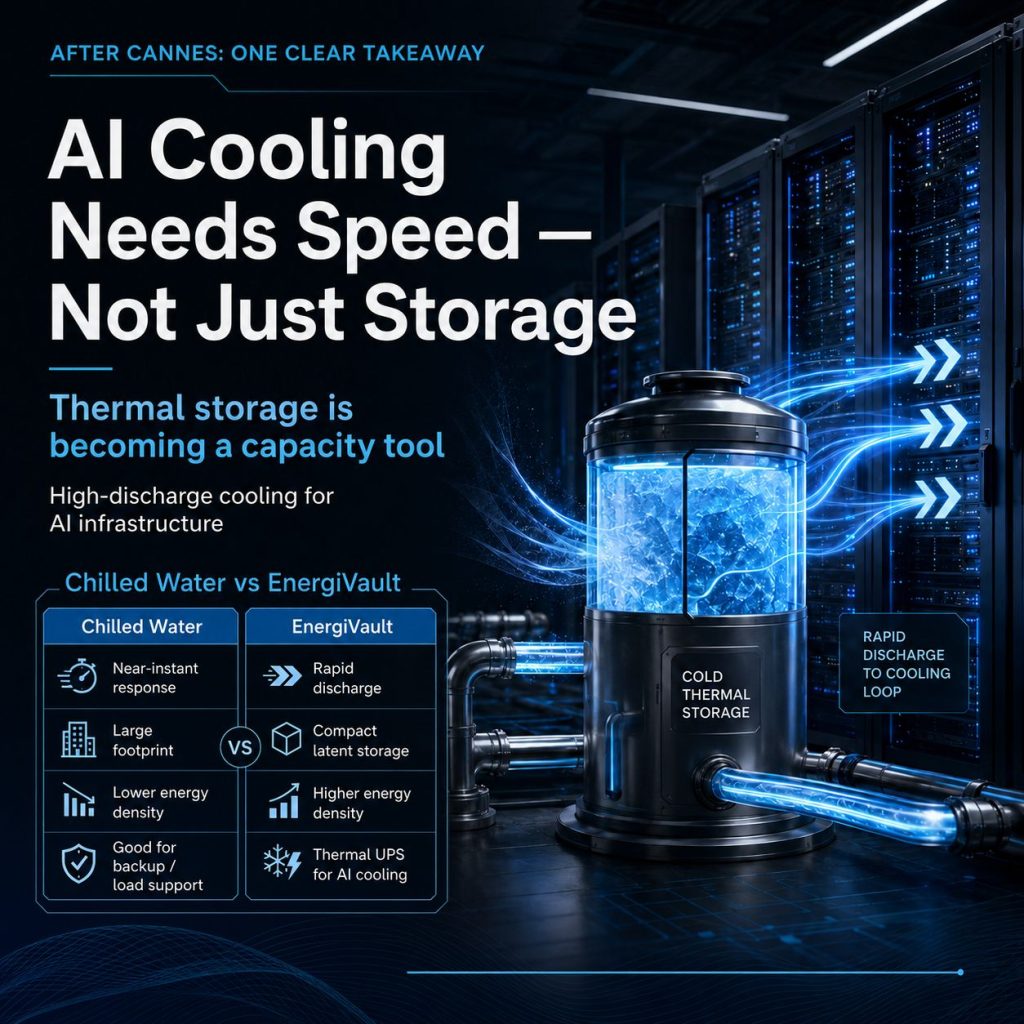
For AI infrastructure, the key question has changed significantly. It is no longer just about how much cooling you can store. Rather, the real challenge is how quickly you can deliver that cooling when the thermal load spikes. This is exactly where EnergiVault differs fundamentally from conventional ice-based thermal storage.
High-Discharge Power and Proven Performance
Of course, traditional ice thermal energy storage offers strong energy density, but it suffers from a slow discharge response. Because of this, we engineered EnergiVault specifically around high-discharge thermal power. Indeed, it combines the energy density of ice with the rapid response needed for critical cooling, liquid cooling support, and AI thermal ride-through.
In addition, we have already proven the platform in a live pharmaceutical deployment. It successfully supported real critical cooling loads under true operational conditions. Consequently, our next step is clear, as we are now seeking a reference deployment within data centre infrastructure.
Strategic Advantages for AI Infrastructure
For operators and infrastructure partners, this technology opens up crucial possibilities:
Thermal UPS for AI cooling
Peak cooling demand reduction
Chiller oversizing reduction
Liquid cooling loop stabilisation
Grid-constrained capacity unlock
Increased IT load within the same electrical envelope
Ultimately, in the AI era, operators can no longer view cooling as passive infrastructure. Instead, it must become dispatchable and resilient. It absolutely needs to respond at the speed AI demands, and that is exactly where we are focusing EnergiVault.
With this in mind, the team welcomes further conversations with professionals working on the next generation of AI-ready data centre infrastructure.